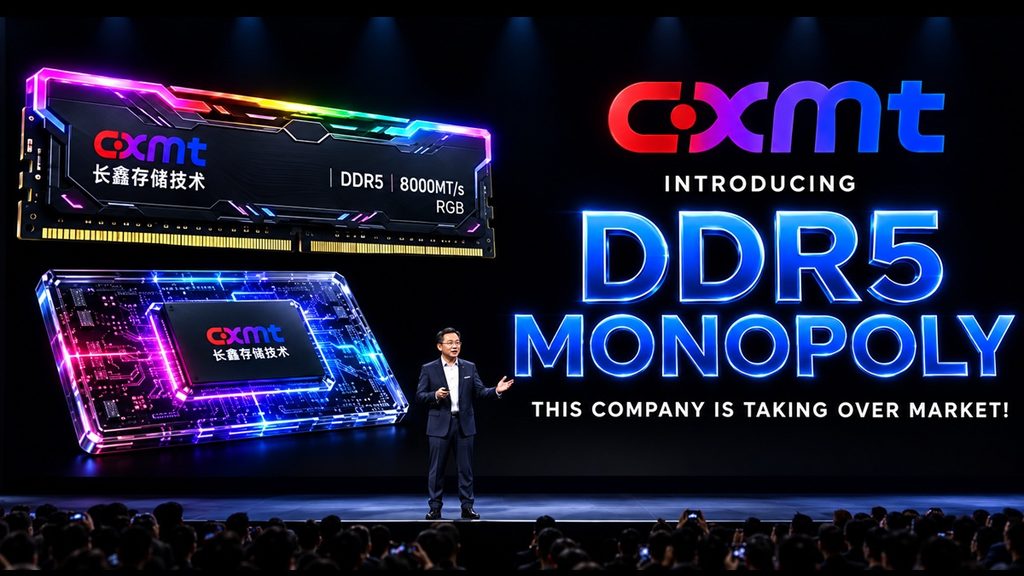
For months, gamers, PC builders, and hardware enthusiasts held on to a single ray of hope amid the ongoing memory price crisis: China’s memory manufacturers.
The logic seemed solid on paper. As established giants like Samsung, SK Hynix, and Micron shifted their production toward lucrative AI-grade High Bandwidth Memory (HBM), China’s ChangXin Memory Technologies (CXMT) would step in to flood the market with affordable DDR5 RAM.
However, recent market data reveals a dramatic plot twist. Instead of undercutting Western and South Korean giants, CXMT’s DDR5 memory modules are now selling at a higher price than Samsung’s. The dream of cheap consumer RAM from China has officially collapsed.
1. Understanding Computer Memory & The AI Breakdown
A. Core Types of System Memory
http://googleusercontent.com/image_generation_content/watermarked_img_4200427389104889812.png
- DDR RAM (DDR4 / DDR5): The primary system memory used in consumer PCs and standard servers. Connects directly to the CPU via a horizontal memory bus to handle active applications.
- NAND Flash: Non-volatile storage memory that retains data without power. Widely used in Solid State Drives (SSDs), USB drives, and smartphone internal storage.
- NOR Flash: Low-capacity storage featuring ultra-fast random read speeds, primarily used for holding boot code and BIOS/UEFI firmware.
- GDDR (GDDR6 / GDDR7): High-speed Graphics DDR optimized for discrete GPUs to handle heavy graphics rendering and high-frame-rate gaming.
B. Specialized AI Memory: High Bandwidth Memory (HBM)
http://googleusercontent.com/image_generation_content/watermarked_img_8192039182374619284.png
High Bandwidth Memory (HBM) is a specialized 3D-stacked DRAM architecture engineered specifically to eliminate data bottlenecking during complex AI model training and inference.
Architectural Breakdown: HBM vs. Traditional Memory Technologies
| Feature | HBM (e.g., HBM3E / HBM4) | DDR RAM (DDR5) | NAND Flash (NVMe SSD) |
|---|---|---|---|
| Architecture | 3D Vertically Stacked DRAM Dies via TSV | Flat Horizontal PCB Stick | 3D Flash Memory Array |
| Bus Width | Ultra-wide: 1024-bit to 2048-bit | 64-bit per channel | N/A (PCIe Lane Dependent) |
| Bandwidth | Extreme: 1.2 TB/s−2.0+ TB/s per stack | Moderate: ∼64 GB/s−100 GB/s | Standard: ∼7 GB/s−14 GB/s |
| Interconnect | Placed directly on Silicon Interposer (CoWoS) | Standard Motherboard DIMM Slots | M.2 Slot / PCIe Channel |
| Primary Role | Large Language Model (LLM) & AI Workloads | General Operating System & CPU Memory | Long-term Data Storage |
C. HBM3E Speed Comparison: SK Hynix vs. Micron vs. Samsung
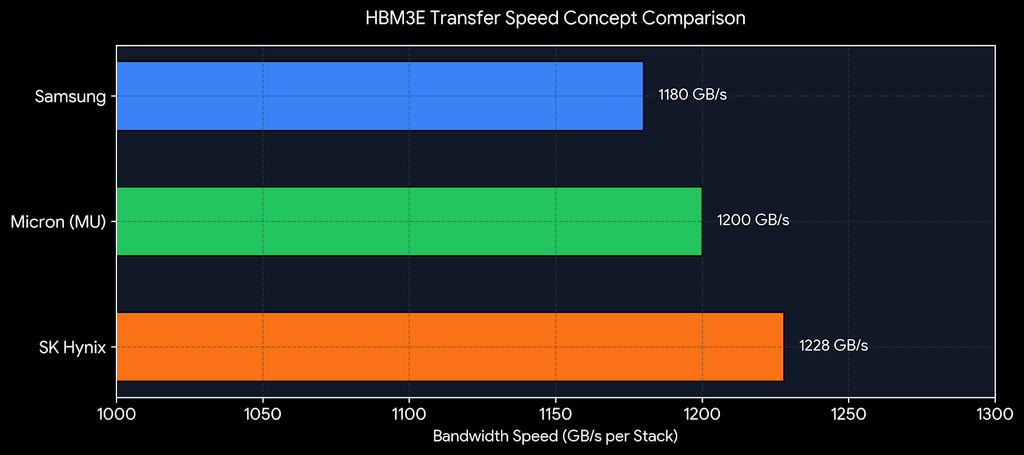
Three major global semiconductor manufacturers dominate the supply chain for advanced AI memory:
- SK Hynix: The market leader holding roughly ∼50%−60% of global HBM market share, recognized for superior thermal dissipation and high manufacturing yields using its proprietary MR-MUF packaging technique.
- Micron Technology (MU): Matches top-tier pin speeds (around 1.2 TB/s) while delivering roughly ∼30% lower power consumption compared to competitors.
- Samsung Electronics: Leads in raw stacking density (e.g., 36GB 12-Hi stacks), though initial qualification speed validation per pin lagged slightly behind SK Hynix in early AI deployment phases.
D. Who Drives HBM Demand? Supply vs. Demand Dynamics
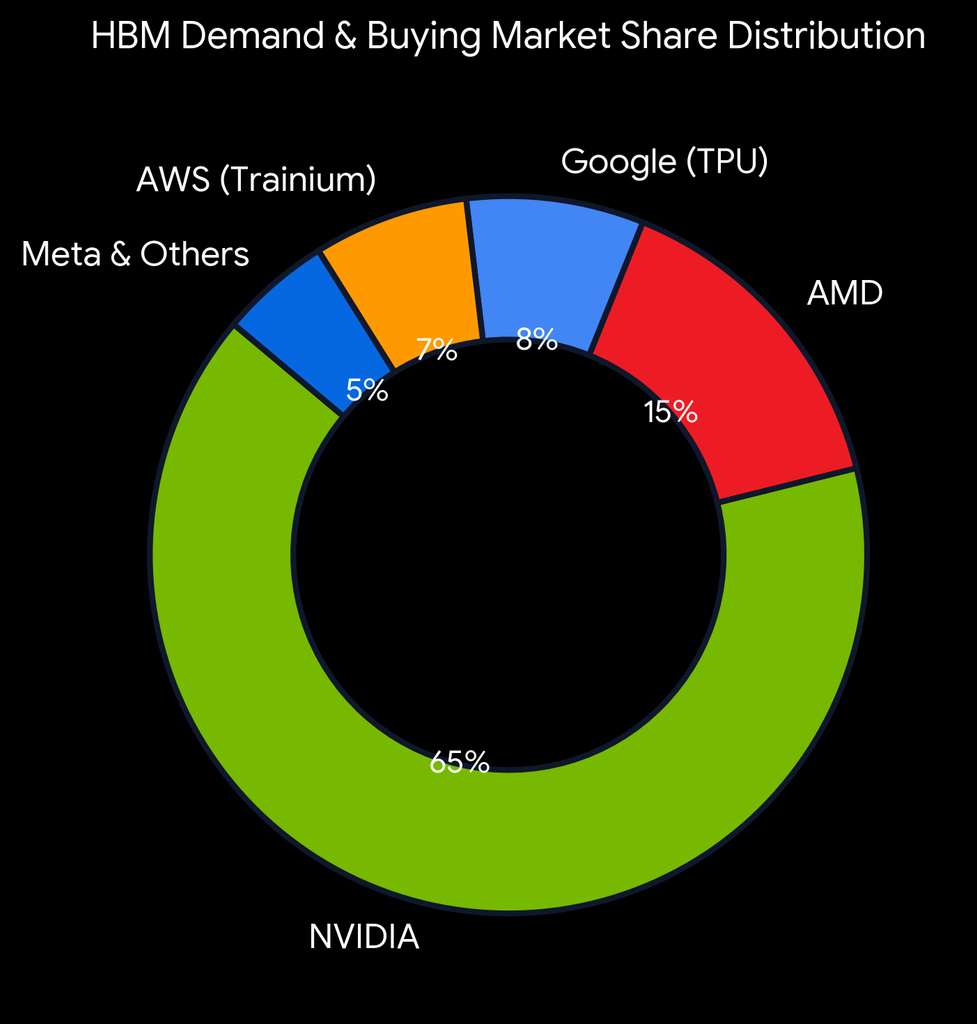
- Key Demand Drivers: Hyperscalers and hardware makers producing AI accelerators—such as NVIDIA (65% share), AMD (15%), Google TPU (8%), AWS Trainium (7%), and Meta (5%).
- Supply Status: Severely Constrained (Sold Out). Producers like SK Hynix and Micron have confirmed their advanced HBM production capacities are completely booked out over an extended horizon. Advanced packaging constraints remain the primary bottleneck in meeting global demand.
E. Stock Valuation: Current Market Price vs. All-Time High (ATH)
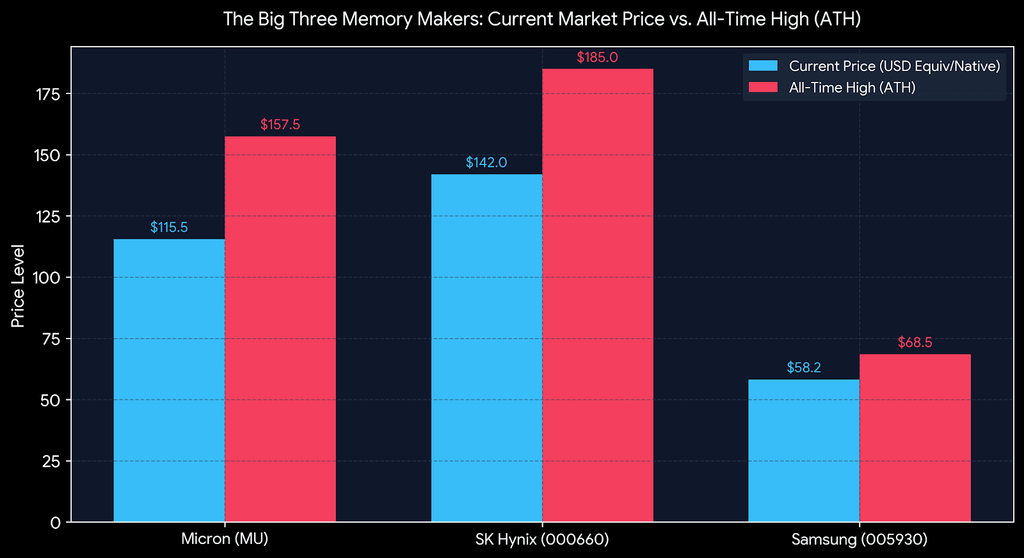
Driven by the massive demand spike during the AI supercycle, market valuations of these three memory leaders saw historic rallies:
- SK Hynix (KRX: 000660): Reached a peak All-Time High (ATH) of ~$185.0 (KRX equivalent) before stabilizing around current levels of ~$142.0.
- Micron Technology (NASDAQ: MU): Hit an ATH of $157.50 driven by strong institutional backing, currently trading around the $115.50 mark.
- Samsung Electronics (KRX: 005930): Reached a peak of ~$68.5 (KRX equivalent), with current market levels hovering near ~$58.2.
2. The Price Shock: CXMT Outpricing Samsung

Industry reports from Reuters and TechPowerUp shattered consumer expectations. CXMT’s 64GB DDR5 server modules are now carrying price tags higher than Samsung’s equivalent offerings.
Even domestic tech behemoths like Huawei—who sought volume discounts—were reportedly refused lower pricing as CXMT held firm on its premium rates. Rather than playing the role of a budget market stabilizer, CXMT has adopted aggressive pricing tactics, maximizing revenue in a supply-starved market.
3. The Root Cause: China’s Own “HBM Obsession”
http://googleusercontent.com/image_generation_content/watermarked_img_3049281740928174029.png
Why is Chinese DDR5 RAM getting so expensive? The answer lies in the domestic AI race:
- Wafer Reallocation: Facing strict U.S. sanctions, Chinese tech firms are heavily reliant on domestic chips. CXMT is forcing immense wafer allocation toward developing proprietary HBM-style stacks for domestic AI processors.
- Yield Efficiency Penalties: Because CXMT lacks access to advanced Extreme Ultraviolet (EUV) lithography tools, its production yields for advanced stacked memory are lower. This burns through significantly more silicon wafers to produce the same quantity of working chips, creating a artificial shortage in general-purpose consumer DRAM.
- Mercantile Strategy: With domestic tech firms desperate for memory supply, CXMT has no commercial incentive to dump cheap consumer RAM into the global DIY PC market when local enterprise clients will pay top dollar.
4. What This Means for PC Builders: “Buy Now or Pay More Later”
For everyday consumers holding out for lower PC component costs, the harsh reality is setting in:
A. No Savior on the Horizon
Industry insiders at COMPUTEX 2026 delivered a blunt message to PC builders: “If you need to buy memory, buy it now. Don’t wait for lower prices, because they won’t appear for the next several years.”
B. Severe PC Build Inflation
A standard 32GB DDR5 RAM kit (16GB x 2) that once cost around $100 has skyrocketed nearly 5-fold, forcing system builders to allocate up to half of their total budget just to secure basic RAM and SSD storage.
Conclusion: The Era of Cheap Memory is Officially Over
The assumption that Chinese manufacturing would rescue PC builders from soaring RAM prices has proven to be a pipe dream. Driven by global AI infrastructure demands and domestic HBM priorities, CXMT has aligned its business model with the legacy ‘Big Three’.
As memory chip makers across the globe prioritize data centers over desktop PCs, everyday users must adapt to a new normal: High-performance memory is no longer a cheap commodity, but a premium luxury.